Is Cumming, GA Water Safe to Drink? 2026 Water Report Explained
Every year, the City of Cumming releases a Consumer Confidence Report showing what was detected in the local tap water. The 2026 report was just released and covers testing performed during 2025. According to the city, the water meets U.S. EPA and Georgia EPD legal standards.
But many homeowners are now aware that legal limits are very different from health-based standards, like those from the Environmental Working Group (EWG). The difference between the two tells a more detailed story.
Several contaminants in Cumming’s 2026 report remain above EWG health guidelines. Some even increased from the prior year. Others improved slightly but are still above what the EWG considers ideal long-term exposure levels.
At Rx Plumbing & Drain, we handle plumbing solutions in Cumming every single day, and lately we’ve seen a major increase in homeowners asking about:
reverse osmosis systems
whole-home carbon filtration
PFAS concerns
chlorination byproducts like THMs and HAA5
This analysis will break down:
what changed from 2024 to 2025
which contaminants exceed EWG guidelines
what the EPA recently updated
which filtration systems actually remove these contaminants
Is Cumming, GA Tap Water Safe to Drink?
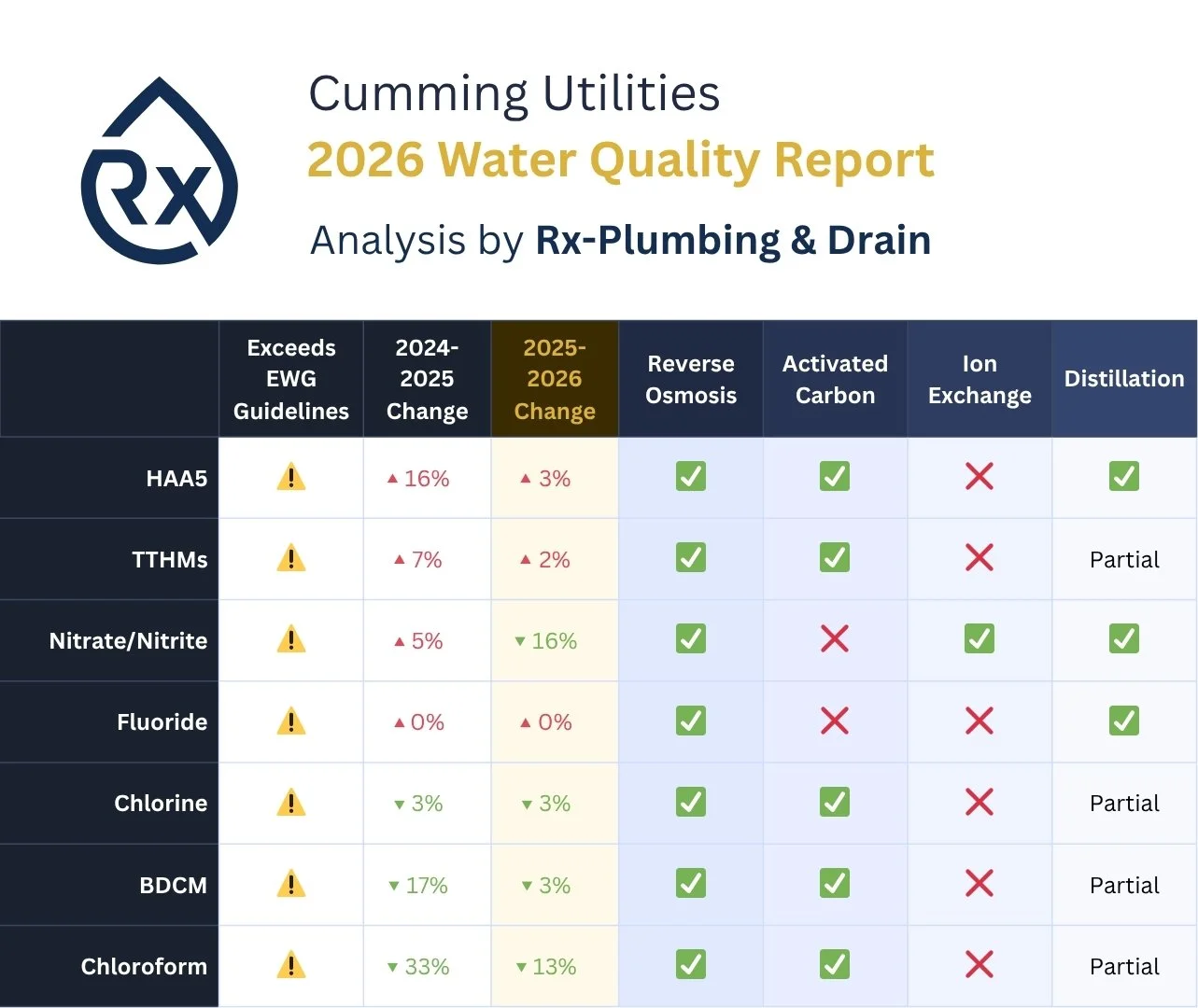
Cumming’s 2026 Water Quality Report shows multiple contaminants that are above the EWG health guidelines, but within the federal and state limits. The main concerns are the high levels of TTHMs, HAA5, BDCM, chloroform, nitrate, chlorine, and fluoride. Most of these contaminants are actually byproducts from the water chlorination process for sanitation. Reverse osmosis is the best in-home water filtration method that effectively reduces every one of these contaminants.
What’s In Cumming’s Water?
Cumming pulls drinking water from Lake Lanier and treats it at the city’s water production facility. The biggest trend in the 2026 report isn’t heavy metals, its disinfection byproducts. These are compounds that form when chlorine reacts with organic matter in surface water.
That matters because Lake Lanier is a surface water source that’s full of:
vegetation
algae
runoff
organic material
When chlorine disinfects water that is rich in organic material like Lake Lanier, compounds like TTHMs and HAA5 form in the freshly cleaned water. The EPA regulates both groups of compounds because long-term exposure to them has been associated with:
bladder cancer
liver impacts
kidney impacts
reproductive concerns
Here’s a snapshot of our analysis of the 2026 Cumming Water Quality Report:
Have EPA Limits Changed Recently?
For most contaminants in the Cumming report, the answer is no.
The EPA limits for TTHMs, HAA5, Chlorine, Nitrate, and Fluoride have remained largely unchanged for many years.
Current federal limits still sit at:
TTHMs: 80 ppb
HAA5: 60 ppb
Chlorine: 4 ppm
Nitrate: 10 ppm
Fluoride: 4 ppm
That’s why Cumming is still fully compliant despite exceeding EWG recommendations.
The important distinction is that EPA standards are legal enforcement limits while EWG standards are health-based goals. EPA limits and EWG guidelines use different standards. The EPA considers cost, available technology, and what cities can realistically achieve. EWG guidelines focus only on long-term health risks regardless of the financial or technological cost involved.
Which one would you rather use to determine the safety of your water? EWG is the only right answer.
Major EPA Changes in 2025 and 2026
The largest recent EPA change involves PFAS.
In 2024, EPA finalized new national drinking water standards for several PFAS compounds. You probably already know about these commonly called “forever chemicals.”
The new limits became dramatically stricter:
PFOA: 4 ppt
PFOS: 4 ppt
This was one of the biggest federal drinking water rule changes in decades.
The EPA also continued implementation of revisions to the Lead and Copper Rule during 2025 and 2026, and Utilities now face:
stricter pipe replacement obligations
lower trigger thresholds
expanded monitoring requirements
However, no major federal tightening occurred recently for:
THMs
HAA5
chlorine
fluoride
Which Water Filters Actually Remove These Contaminants?
Not all filtration systems work equally. Many homeowners buy pitcher filters expecting reverse osmosis performance, but that’s not how it works. Various methods have varying effectiveness for different contaminants. When it comes to the stuff in Cumming’s water, Reverse Osmosis is the best in-home option for consumers. Unlike Activated Carbon or the other filtration methods, Reverse Osmosis effectively filters each and every contaminant in Cumming’s water.
Is Reverse Osmosis Worth It in Cumming?
For many homeowners, absolutely.
Reverse osmosis systems are one of the few residential filtration methods that effectively reduce:
fluoride
nitrates
VOCs
THMs
HAA5
PFAS
dissolved solids
A properly designed RO system with carbon pre-filtration usually provides the best contaminant reduction available for in-home drinking water.
This is a non-negotiable for homeowners concerned about:
children
taste and odor
chlorination byproducts
long-term exposure
So Is Cumming Water Safe?
It depends what criteria you want to use to determine safety for your own family. That much is up to you at the end of the day.Legally, the answer is ‘yes.’
The water currently complies with EPA and Georgia drinking water regulations. But many contaminants remain above EWG’s stricter recommendations that are based purely on the water’s effect on your health. These are common in many communities that use chlorinated surface water systems.
The real question is really:
What level of filtration gives your household peace of mind?
Water Filtration Systems We Commonly Recommend
The best system depends on your goals.
For taste and chlorine:
activated carbon filtration
For comprehensive contaminant reduction:
reverse osmosis
For whole-home chlorine reduction:
whole-home carbon filtration systems
For PFAS, nitrates, and fluoride:
reverse osmosis systems specifically
FAQs on Tap Water Quality
Is Cumming, GA tap water safe to drink?
It depends how you define ‘safe’ for your own family. Cumming’s water met EPA and Georgia drinking water standards in the 2026 report, but those standards take the economic cost of filtration into account. When using the EWG health-only guidelines, Cumming’s water is not considered safe.
What contaminants exceeded EWG guidelines in Cumming’s 2026 water report?
The main contaminants were:
TTHMs
HAA5
BDCM
Chloroform
Nitrate
Chlorine
Fluoride
Most of these are chlorination byproducts.
What are TTHMs in drinking water?
TTHMs are chemical byproducts created when chlorine reacts with organic material in water. Surface water systems like Lake Lanier commonly produce these compounds during treatment.
What is HAA5?
HAA5 stands for five regulated haloacetic acids. These compounds form during the disinfection process when chlorination interacts with waterborne organic materials.
Why does my water taste earthy or smell like chlorine?
Lake water, like what Cumming pulls from Lake Lanier, changes throughout the year. Algae growth and organic material can affect taste and odor. Chlorine treatment can also increase chemical smell and activated carbon filters can often improve both issues.
Does a Brita filter remove chlorine and TTHMs?
Brita-style carbon filters can reduce some contaminants, like:
chlorine
some TTHMs
taste and odor compounds
Reverse osmosis systems remove far more contaminants.
Does reverse osmosis remove fluoride?
Yes. Reverse osmosis systems reduce fluoride very effectively. RO systems also reduce:
nitrate
PFAS
TTHMs
HAA5
VOCs
What is the best water filter for homes in Cumming, GA?
The best filter depends on your goals.
For taste and odor:
Activated carbon filtration
For full contaminant reduction:
Reverse osmosis
For whole-home chlorine reduction:
Whole-home carbon filtration and reverse osmosis
Are chlorine and fluoride above EPA limits in Cumming?
No. Both remained below EPA legal limits. However, both exceeded stricter EWG recommendations and ideal exposure targets.
Have EPA drinking water standards changed recently?
Yes and no. EPA recently finalized new PFAS (forever chemicals) drinking water limits and continued updates to Lead and Copper Rule enforcement. However, federal limits for TTHMs, HAA5, chlorine, and fluoride have not changed significantly in recent years.
Why are EWG guidelines lower than EPA limits?
EPA standards are legal enforcement limits that take economic cost into consideration while EWG guidelines focus only on long-term health exposure risk.
What water filtration system removes the most contaminants?
Reverse osmosis systems remove the widest range of contaminants found in municipal drinking water. Many systems also include activated carbon filtration to reduce chlorine and VOCs.
Need Help Choosing a Water Filtration System?
At RX Plumbing & Drain, we help homeowners across:
Cumming
Sugar Hill
Buford
Alpharetta
Johns Creek
North Atlanta
select and install:
reverse osmosis systems
whole-home carbon filters
water softeners
under-sink filtration systems
If you want to improve taste, reduce chlorine byproducts, or understand your home’s water quality better, we can help you choose the right setup for your goals. Simply reach out today to learn more or set up quick service.